

AI agents for scientific research are rapidly gaining attention. Systems built on large language models (LLMs) can now run quantum chemistry workflows, plan experiments, and analyze data. But almost all of them share the same hidden bottleneck: every tool they use, including every geometry optimizer, spectrum analyzer, and simulation wrapper, was hand-built and hand-integrated by a human engineer. When a new method appears, a library updates, or the research question drifts to a neighboring domain, a developer has to step in. Agents are limited by frozen toolbox.
What if the agent could simply forge its own tools?
That is exactly what our new system does. We present El Agente Forjador (”The Forging Agent”), a multi-agent framework in which universal coding agents autonomously forge, validate, organize, and reuse computational tools (paper link). Give it a scientific task in plain language, and it figures out which tools it needs, builds the missing ones from the actual source code of installed scientific libraries, tests them, and composes them into a working pipeline.
Evaluated on 24 research tasks spanning quantum chemistry and quantum dynamics, across five different coding-agent setups and over 1,000 task runs, the result is striking: a curriculum-built toolset cuts API costs by 33–78%, slashes wall-clock time by up to 88%, and lifts weaker models by as much as 16.5 percentage points in task success, all at the same time.
This agent doesn’t need your hand curated toolbox, It has a forge.
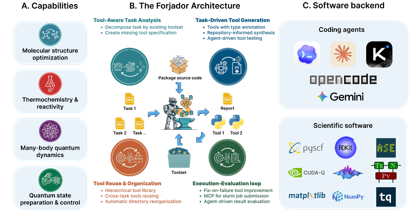
Figure 1: Overview of El Agente Forjador. (A) The system is evaluated on quantum chemistry and quantum dynamics tasks, from molecular structure optimization and thermochemistry to many-body dynamics and quantum control. (B) The Forjador workflow runs in four stages: tool analysis, tool generation, task execution, and solution evaluation, iterating until the task is solved. Each task produces a report and a growing library of reusable tools. (C) The software backend: general-purpose coding agents (Claude Code, Codex, OpenCode) driving scientific packages like PySCF, QuTiP, TenPy, and CUDA-Q.
What Makes This Work Worth Your Attention
Three core ideas are behind our designs:
1. Tools should be generated from the task
Traditional scientific agents ship with a fixed, expert-curated toolset. El Agente Forjador inverts this: when a task arrives, a tool analyzer decomposes it into computational stages, checks the existing library, and writes specifications for whatever is missing. A tool generator then reads the source code of the installed scientific packages directly, guaranteeing the exact interface of the exact installed version, then implements the tool in Python, writes unit tests, and iterates until everything passes. A separate reviewer agent checks correctness before the tool enters the shared library.
The consequence is a paradigm shift: agent capabilities are defined by the tasks they are asked to solve, not by what engineers anticipated in advance.
2. A curriculum that turns tool generation into knowledge transfer
Because tools persist across tasks, ordering tasks from simple to complex creates a natural curriculum: an early task like “optimize the geometry of methane” forges foundational structure-generation tools; later tasks like “compute the pKa of acetic acid in solution” reuse them and add solvation tools on top. A toolset optimizer keeps the growing library navigable by reorganizing it into a hierarchy, and agents discover tools through progressive disclosure, seeing only the branches relevant to their task.
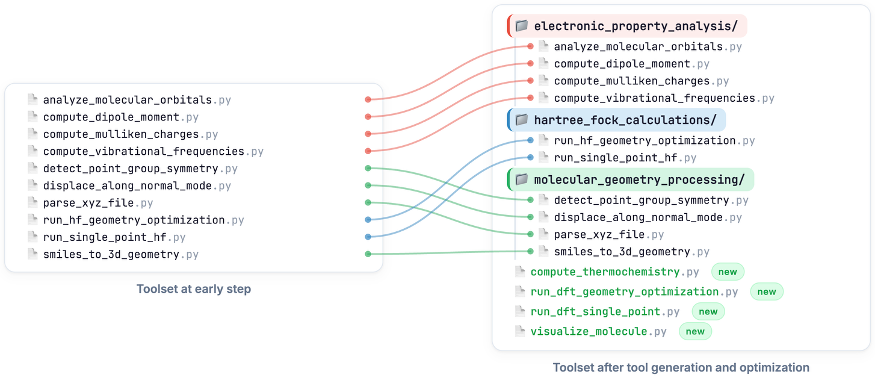
Figure 2: Toolset optimization during curriculum learning. Left: A flat toolset at an early stage. Right: After optimization, tools are reorganized into hierarchical subcategories, and newly generated tools (green) are added at the root awaiting future reorganization.
Here is the most surprising payoff: build the toolset once with a strong model (Claude Opus 4.6), and weaker models can reuse it. Kimi K2.5 jumps from 65.7% to 82.2% on quantum chemistry simply by composing well-tested tools forged by a stronger agent. Correct domain methodology gets encoded into the tools themselves as a form of strong-to-weak knowledge transfer through tool interfaces.
3. Universal agents create a self-healing tool ecosystem
Every agent in the framework, including the analyzer, generator, executor, and evaluator, is a full coding agent that can read, write, execute, and debug anything in the shared workspace. Tools are often imperfect when first forged, but when a downstream agent hits a bug while reusing one, it has both the access and the capability to fix it on the spot. Bugs surface exactly where they matter, and the same agent that encounters them repairs them.
No human maintenance. The toolset gets better the more it is used.
1,080 Runs, Five Different AI Models
We benchmarked the framework on 13 undergraduate-level quantum chemistry tasks (geometry optimization, carbocation stability, ring strain energy, pKa prediction, TD-DFT spectra) and 11 quantum dynamics tasks (VQE dissociation curves, optimal control, open-system dynamics, phase diagrams with DMRG), using five coding-agent setups: Claude Opus 4.6 and Claude Sonnet 4.6 via Claude Code, GPT-5.2-Codex via Codex, and Gemini 3.1 Pro and Kimi K2.5 via OpenCode.
Each model was tested in three operating modes: zero-shot tool generation, where the agent starts each task with an empty toolset and forges tools from scratch; tool reuse, where the agent uses a curriculum-built library generated by Claude Opus 4.6, a high-performance LLM; and evaluator only, where the coding agent solves the task directly without tool generation or tool reuse, but keeps an evaluation loop for fairness.
We show that the generated toolset can transfer ability to the agents who use it. The headline numbers:
Tool reuse improves accuracy: average scores rise from 81.5% to 85.8% on quantum chemistry and from 91.5% to 93.2% on quantum dynamics, with the biggest gains for weaker models.
Tool reuse slashes cost: API costs drop by 33–78% across models and benchmarks, because agents skip the expensive tool-generation loop and go straight to composition.
Tool reuse slashes time: wall-clock time drops by up to 88%. Claude Opus 4.6 went from over two hours per quantum dynamics task to about 15 minutes.
Tools Forged in One Domain Compose in Another
The real test of a tool library is whether it generalizes beyond the domain it was built for. We merged a quantum chemistry toolset with a quantum dynamics toolset and gave the agent hybrid problems that no single domain could solve.
Case study: Ethylene excited states via TD-DFT and Quantum Subspace Expansion
The agent computed the excited states of ethylene by combining TD-DFT (classical quantum chemistry) with Quantum Subspace Expansion (a quantum algorithm simulated with CUDA-Q), reusing five existing tools across three software ecosystems and forging three new ones on the fly, including a complete QSE implementation that passed automated testing before use.
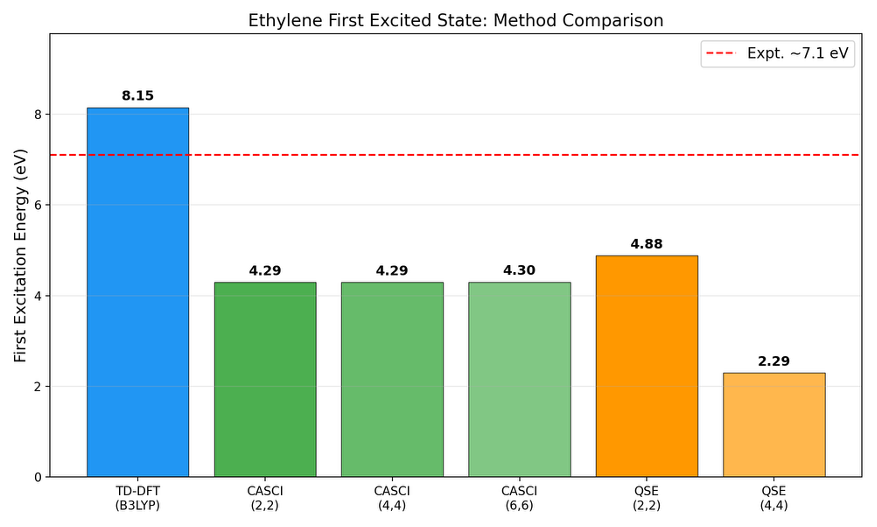
Figure 3: Comparison of first excitation energies from TD-DFT, CASCI, and QSE for ethylene.
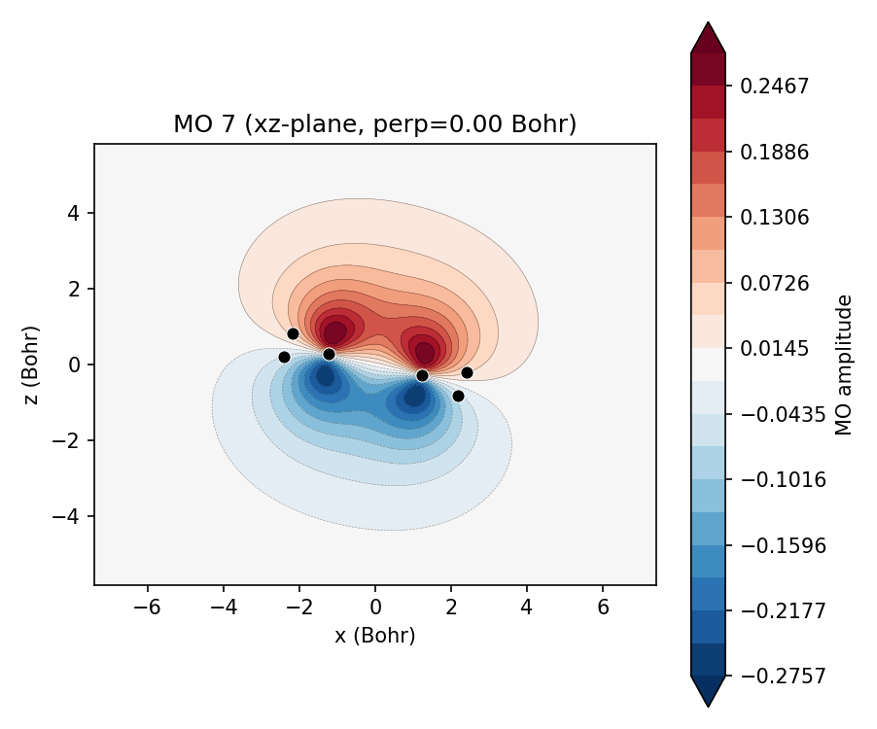
Figure 4: Frontier orbital visualizations generated by a newly forged tool.
Missing capabilities are forged on demand. Existing tools cross domain boundaries. The library composes.
Beyond Quantum Simulation
The deepest bottleneck in scientific AI is it is the human engineering required to connect the increasingly intelligent model to scientific software. Every hand-built integration is a tax on progress, paid again and again as science moves.
El Agente Forjador points to a different equilibrium. If agents can forge, validate, and maintain their own tools, then:
scientific agent systems become defined by tasks, not by engineering; researchers specify what to compute, and the infrastructure emerges;
capability transfers through tools; one strong model builds a library that makes every cheaper model better; and
toolsets become living scientific assets that grow, self-repair, and compose across disciplines.
Nothing in the framework is specific to Quantum Chemistry and Quantum Dynamics: any field with rich computational libraries, including materials science and drug discovery, could be next.
This work was the joint efforts of many co-authors: Zijian Zhang (me), Aiwei Yin (co-first), Amaan Baweja, Jiaru Bai, Ignacio Gustin, Varinia Bernales (corresponding), and Alán Aspuru-Guzik (corresponding). Preprint can be found at: link.